

A central concept within incel ideology claiming that 80 per cent of women are interested only in the most attractive 20 per cent of men. The remaining 80 per cent of men are said to compete for the attention of the least attractive 20 per cent of women or remain alone. Feminism, described as the dominant ideology of the present day, is portrayed as responsible for this dynamic. There is no empirical evidence to support the claim that women base partner selection primarily on physical appearance or consistently prefer traditionally “masculine” traits.
Algorithms are sets of programmed instructions that guide computer systems. On social media platforms, they function as recommendation systems that determine which content appears in personalised feeds. Algorithmic systems track user behaviour and adjust content accordingly. Platforms such as TikTok often amplify material that generates high engagement, including views, likes and comments. This creates incentives for emotionally charged or polarising content. For this reason, algorithms are widely regarded as contributing factors in processes of polarisation, radicalisation and the spread of hate speech.
Alpha masculinity is a shorthand term used within the manosphere to describe ideals of masculinity emphasising dominance, assertiveness, toughness, strength, authority and independence. The related concept of hypermasculinity refers to an intensified or exaggerated form of these traits, often associated with rigid gender roles and the rejection of perceived weakness.
The alt-right, more commonly referred to in the German-speaking context as the “Neue Rechte”, is a collective term for far-right political movements advocating forms of male, Christian and white supremacy. In the United States, elements of the alt-right gained mainstream political visibility during the presidency of Donald Trump (2016–2020 and from 2024 onwards).
Andrew Tate is a former kickboxer who has gained billions of views on social media through misogynistic statements and hypermasculine self-presentation. Through the platform “The Real World”, he markets courses promising rapid financial success. Tate is widely regarded as a prototypical manfluencer. He is currently facing various criminal charges, including allegations of rape, human trafficking and financial offences.
Androcentrism describes the condition in which male perspectives and male norms are treated as universal standards within patriarchal societies. The male viewpoint is considered neutral and objective, while female perspectives are framed as deviations. Pierre Bourdieu herefore refers to an “androcentric unconscious”.‹.20 Because societal androcentrism remains deeply embedded, boys may internalise assumptions of male entitlement during socialisation. This can result in the mistaken belief that men have a legitimate claim to greater social, economic or symbolic resources. The counter-concept is gynocentrism.
Antifeminism refers to an ideological worldview based on the unfounded claim that the state has been infiltrated by feminists hostile to men. According to this narrative, such actors seek to impose an unnatural egalitarian gender order through re-education, propaganda and the silencing of dissent.
Banter refers to teasing, ironic or provocative exchanges common in some manosphere contexts. It can foster belonging while operating through exclusion or derogation, often directed at women. Irony frequently functions as a protective shield, with harmful statements reframed as “just a joke”.
As Franziska Schutzbach argues in her analysis of pick-up artist culture, this form of ironic distancing can normalise aggressive or violence-legitimising attitudes by presenting them as playful or socially acceptable.21
Within incel subculture, “betas” refers to men perceived as moderately attractive and socially average. The corresponding label for women is “Becky”. Both are sometimes described as “normies”.
Binary gender order refers to the culturally embedded but scientifically unsupported assumption that all people belong exclusively to one of two categories: male or female. Within this framework, gender diversity is not recognised as legitimate.
Black Pill ideology is described as a more nihilistic derivative of Red Pill ideology (Kracher 2020). The distinction centres on whether perceived injustices can be overcome through personal development. Adherents of Black Pill ideology reject the possibility of change. They interpret romantic exclusion as predetermined and abandon hope of meaningful relationships.22
In incel discourse, “Chads” refers to men believed to possess genetic and physical advantages granting unrestricted access to sexual and romantic relationships.
Derived from Latin meaning “on this side”, cis describes individuals whose gender identity corresponds with the sex assigned at birth. It is the counterpart to trans.
Doing Gender refers to the ongoing social process through which gender is constructed in everyday life. Individuals enact gender by behaving in ways that align with cultural expectations and their own gender identity. From this perspective, gender is not fixed but socially produced and therefore open to variation.
Certain emojis, such as the red pill, the “100” symbol or the wolf, can signal affiliation with manosphere narratives.23 However, meanings are fluid and context-dependent, requiring cautious interpretation.
Essentialism refers to the belief that biological sex fully determines social gender. Gender roles are understood as natural or divinely ordained, and variation is not recognised. Essentialist thinking frequently presents cultural myths as natural laws, defining “real men” and “real women” as predetermined categories.
Feminism is a collective term for diverse theoretical approaches and social movements united by the understanding that gender is a central organising principle in society. From feminist perspectives, gender structures can restrict freedoms and reproduce inequality. Feminist analysis highlights how structural privilege benefits some groups while disadvantaging others
Gender refers to the social and cultural dimensions of sex. It is distinguished from “sex”, which refers to biological characteristics. Because German does not clearly separate these meanings in everyday language, the English term “gender” has also been adopted as a loanword.
Gender bias refers to the often unconscious tendency to interpret information in ways that align with gender stereotypes.
Gender-reflective practice is an umbrella term encompassing gender-sensitive and gender-transformative professional approaches. It refers to forms of practice that critically consider gender and, where appropriate, aim to challenge unequal gender structures.
Gynocentrism refers to a focus on women’s perspectives and concerns. Within manosphere discourse, the term is primarily used polemically by actors who perceive themselves as disadvantaged by processes of emancipation. Such actors portray women, contrary to empirical evidence, as beneficiaries of patriarchal structures. They claim that society is organised around gynocentrism and that men are subjected to systemic hostility, often framed as misandry.
A hater is a general term for individuals who express hostility through derogatory comments about public figures on social media. Such attacks disproportionately target women.
Hegemonic masculinity is a concept developed by the sociologist Raewyn Connell24 within critical masculinity studies. It does not primarily describe a cultural ideal, but a dynamic pattern of male dominance. The concept analyses how certain forms of masculinity become socially legitimised and sustain power hierarchies.
Heteronormativity refers to the societal assumption that men desire women and women desire men. Other forms of desire are framed as deviations and have historically been pathologised. Heteronormativity is closely linked to homophobia.
Homophobia refers to fear of, aversion to or hostility towards homosexual people.
Homosociality describes the tendency to seek the company of people of the same sex for non-sexual reasons. In masculinity research, the term often appears in expressions such as “homosocial pressure”, referring to how men monitor and enforce masculine norms within peer groups.
Incels, short for Involuntary Celibates, is a self-description used within a specific online milieu of psychologically highly burdened young men. They interpret rejection by women as the result of what they perceive to be an unnatural reversal of a supposed natural gender order. Feminism and women’s emancipation are identified as the cause. Although primarily rooted in online spaces, incel ideology has been linked to real-world violence.
Intersectionality refers to the analysis of overlapping and interacting forms of discrimination. Like traffic at a crossroads, disadvantage can operate along multiple axes simultaneously. For example, discrimination experienced by a Black woman may be shaped both by sexism and racism. 25
Jordan Peterson is a Canadian psychologist, author and emeritus professor. During the 2010s, he gained wide public visibility by advocating a return to traditional gender roles and popularising masculinity ideologies, particularly among young men. He is often described as an early intellectual reference point within manosphere-adjacent discourse.
Kill-scoring, also referred to as body count ranking, describes the practice of counting and publicly displaying eliminated opponents in gaming contexts. The display serves to signal status and competitive dominance.
LDAR stands for “Lie Down And Rot”. Within incel milieus, it describes an attitude of resignation toward a perceived inescapable social or sexual situation. LDAR reflects a fatalistic stance in which individuals abandon attempts at change and interpret their situation as predetermined. It is closely associated with Black Pill ideology.
Male supremacy refers to the ideological belief in the genetic and societal superiority of cis men. From this belief, proponents derive a perceived entitlement to the subordination of women and LGBTQI+ individuals.
Manfluencers are masculinity coaches with a strong social media presence who promote philosophies and services related to manhood. Central themes include dating, fitness, health, status, wealth and career success. The guiding premise is that men must optimise themselves through the deliberate performance of masculinity in order to achieve fulfilment.
Manfluencer literacy refers to the competence to critically assess and recognise the commercial strategies, aesthetic staging and persuasive techniques used by manfluencers. It includes awareness of how symbolic codes, framing devices and emotional appeals are employed. The concept aligns with media education approaches aimed at strengthening democratic resilience in contexts of social and political change. (cf. point 2 of the recommendations for action for political media education in the context of democracies in transition).
The manosphere is an umbrella term for online spaces and discourses in which men defend notions of a supposedly natural masculinity, perceive male dominance as under threat and attribute this perceived threat to women, feminism or gender equality.
Manhood refers to how an individual man relates to societal expectations of masculinity. Men position themselves, consciously or unconsciously, in relation to dominant masculinity norms. This positioning is described as male self-relation.
Male self-relation describes the relationship between an individual man and socially dominant expectations of masculinity. It is understood as an ongoing learning process. Because masculinity norms are socially constructed, they can be reshaped. There are different ways of being a man. This distinction forms a central preventative and empowering message for boys and men.
Masculinity refers to the social and cultural expectations a man is expected to fulfil in order to be recognised as masculine. Manhood, by contrast, refers to individual self-understanding and lived experience. Terms such as masculinity norms, masculinity expectations or masculinity imperatives emphasise the normative character of masculinity. The term toxic masculinity is widely used in public debate to criticise harmful patterns. However, because it can be perceived as accusatory, professionals often prefer more descriptive language. Research shows that rigid masculinity norms are associated with increased risks of violence and health-endangering behaviour.
Masculine discrepancy stress refers to the stress experienced by boys and men who perceive themselves as failing to meet socially prescribed masculinity expectations. Research links this form of stress to various psychological and behavioural risks.
Men’s Rights Activism refers to an ideological current portraying primarily white, heterosexual, cis men as disadvantaged by women’s emancipation and feminist progress. Activists claim to advocate for gender equality while grounding their arguments in a narrowly quantitative and ahistorical understanding of equality that neglects structural and sociohistorical dimensions of gender relations.
Maxxing is a subcultural umbrella term referring to attempts to optimise specific aspects of one’s body. Looksmaxxing refers to improving physical appearance. T-maxxing refers to attempts to increase testosterone levels. Practices can take extreme forms, including surgical alterations or the use of anabolic steroids, and may pose significant health risks.
Memes are digital media formats combining image, text and sound, often with humorous or satirical intent. Within online communities, memes function as markers of belonging and shared understanding. Their meanings are shaped by subcultural codes and can shift rapidly, making interpretation difficult for outsiders. A frequently referenced example within the manosphere is Pepe the frog.
MGTOW, short for Men Going Their Own Way, is a self-description used by men who frame the absence of long-term relationships not as a grievance but as a conscious choice. Sexual and emotional independence from women is elevated as an ideal of sovereignty.
Misogyny literally means hatred of women. It refers both to individual attitudes that legitimise contempt or violence and to structural dynamics within patriarchal societies. Misogyny functions as a control mechanism prescribing how women should behave and as a punitive mechanism when they deviate from these expectations.27
Pick-up artists promote seduction as a systematised technique aimed at initiating sexual contact with as many women as possible. Dating coaches market scripts, routines and behavioural strategies designed to increase perceived success and manipulate attraction.
In this context, progressive refers to pro-feminist and emancipatory currents within work with boys and men and gender policy. It is grounded in the conviction that equitable gender relations require a more equal distribution of paid and unpaid labour.
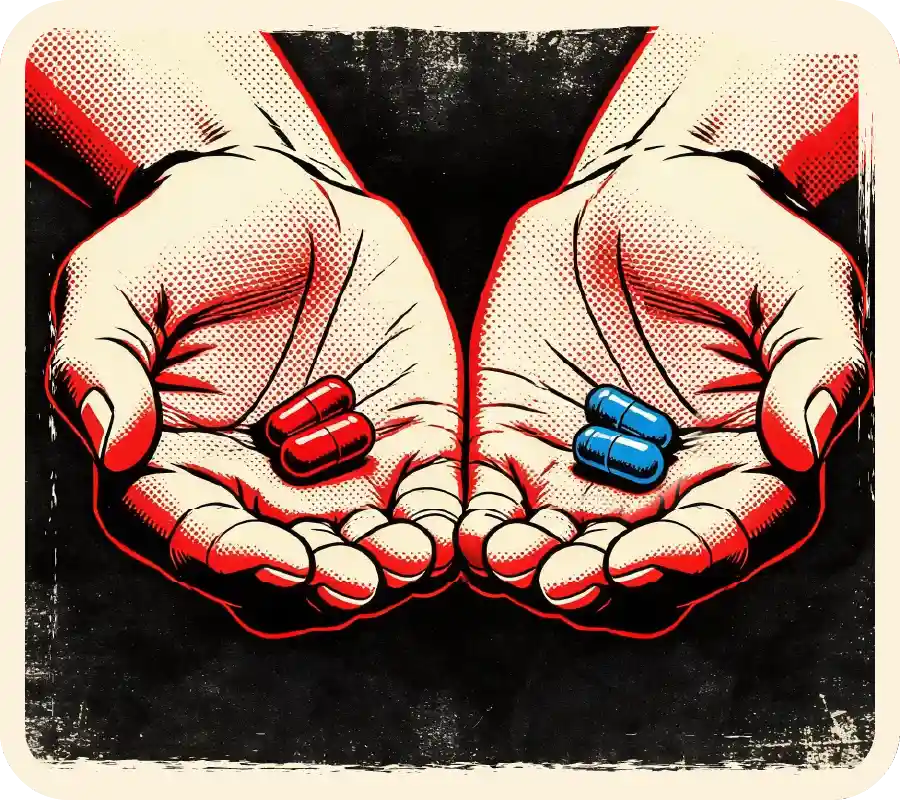
The red pill metaphor originates from the film The Matrix (1999). Within the manosphere, it symbolises awakening to the belief that global society is manipulated by feminists and that men are victims of a gynocentric order. To “red-pill” someone means to convert them to this worldview. Those who reject it are labelled “blue-pilled”.
The sigma male represents an alternative masculinity archetype: the self-sufficient “lone wolf” who operates independently of social hierarchies. The character Patrick Bateman in American Psycho is frequently referenced as a prototype.
Sigma Boy refers to a 2024 internet phenomenon popularised through TikTok by Russian bloggers. The term depicts a mysterious and self-confident young male archetype.
Simping is a derogatory term for behaviour perceived as submissive or overly deferential when a man seeks a woman’s approval.
Socialisation describes the process through which individuals develop stable patterns of perception, evaluation and behaviour through interaction with their environment. These patterns shape what is considered normal and appropriate within a society.
In incel discourse, “Stacys” refers to women perceived as highly attractive and believed to possess unrestricted romantic choice. The term functions as a stereotype within a hierarchical worldview based on perceived attractiveness.
(“Supreme Gentleman” is a term used within incel communities to refer to Elliot Rodger, who carried out a mass killing in Isla Vista, California, in 2014. His manifesto articulated an explicitly misogynistic worldview and has been treated as an ideological reference point by militant strands of the incel movement.
Toxic masculinity is a term used in public discourse to criticise dominant societal models of masculinity that associate being “masculine” with aggression, emotional suppression and the subordination of women.28 The concept is not uniformly defined and is used cautiously in academic contexts. In scholarly discourse, more descriptive terms such as masculinity norms, masculinity expectations or masculinity imperatives are generally preferred, as they emphasise structural patterns rather than attributing inherent toxicity to men themselves.
Tradwives, short for “traditional wives”, refers to a social media trend in which influencers idealise domesticity, female self-sacrifice and traditional gender roles. The trend often intersects with anti-feminist and traditionalist narratives.
Derived from Latin meaning “across” or “beyond”, trans refers to people whose gender identity does not correspond with the sex assigned at birth. It is the counterpart to cis and is commonly used as a shortened form of transgender.
Work with boys and men refers to professional practice in which practitioners engage boys, men and fathers in gender-reflective processes of identity development. The aim is to strengthen relational and life competences and to support constructive participation in more equitable gender relations.26
Zero sum refers to the mistaken assumption that gains in gender equality for women necessarily result in losses for men. This perspective overlooks how boys and men can also benefit from more flexible masculinity norms.